
Many car owners have such a confusion: obviously the car has not been hit or repaired, but the fuel consumption suddenly soars; the idle speed is unstable when cold starting, the acceleration is weak and accompanied by jitters; the exhaust gas exceeds the standard during annual inspection, and it cannot pass even after repeated rectifications… In fact, the root cause of all this may point to an “invisible hero” you have almost never paid attention to – the automotive oxygen sensor.
Hidden on the engine’s exhaust pipe, it is small in size and ordinary in appearance, but it can be called the “intelligent brain” of the car engine, controlling the core code of fuel combustion. Today, we will uncover the secrets of automotive oxygen sensors, so that you can understand: this unremarkable small part can not only help you save a lot of money, but also protect your driving safety. Choosing the wrong one or using it incorrectly may “shorten the life” of your car.
Secret 1: It’s Not an “Ornament”, but the Engine’s “Fuel Regulator”
Many car owners mistakenly believe that the oxygen sensor is just a “dispensable” auxiliary part, and some even directly remove it to save trouble after it is damaged – this is actually ruining your car with your own hands.
The core function of the oxygen sensor is to real-time monitor the oxygen content in the exhaust gas of the exhaust pipe, and then transmit the signal to the engine ECU (Electronic Control Unit). According to this signal, the ECU accurately adjusts the fuel injection volume and air intake volume, so that the fuel and air reach the optimal mixing ratio (ideally 14.7:1, that is, 14.7 parts of air mixed with 1 part of fuel).
Simply put, it is like a “precision housekeeper”: when the oxygen content in the exhaust gas is too high (insufficient fuel), it will remind the ECU to inject more fuel; when the oxygen content is too low (excessive fuel), it will let the ECU reduce the fuel injection volume. Without it, the engine will “inject fuel blindly”, either the fuel will not burn fully, or the fuel will be wasted, directly leading to soaring fuel consumption and excessive exhaust gas.
Data shows that after the oxygen sensor is damaged, the vehicle’s fuel consumption will directly increase by 10%-30%. For a car with a fuel consumption of 8L per 100 kilometers, driving 20,000 kilometers a year will cost thousands of yuan more in fuel alone – this is not a small amount!
Secret 2: Its “Health” Directly Determines the Engine’s Lifespan
The engine is the “heart” of the car, and the oxygen sensor is the “sentry” guarding the heart. Its working state directly affects the wear degree and service life of the engine.
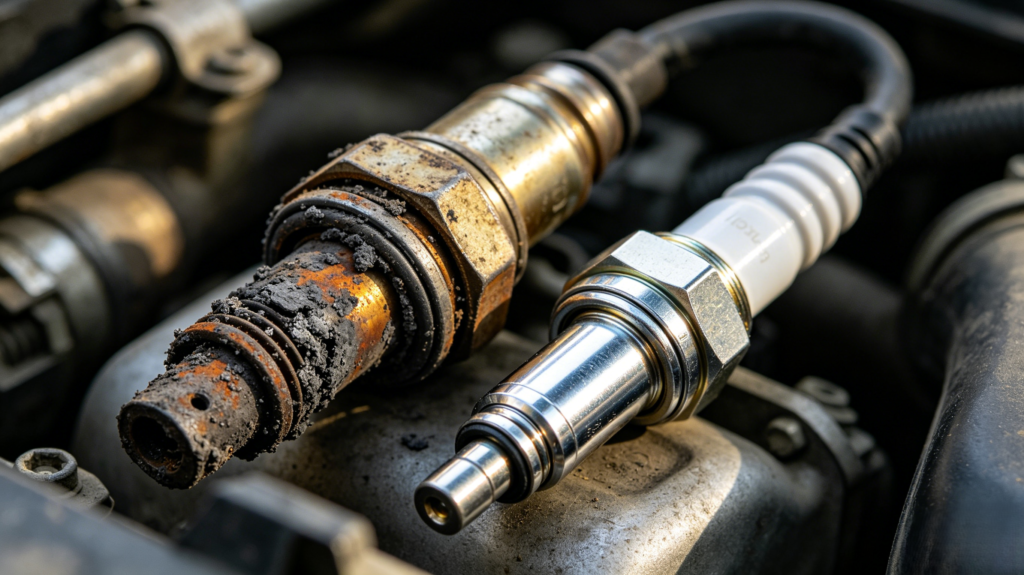
When the oxygen sensor ages or is damaged and cannot transmit signals accurately, the fuel mixing ratio of the engine will be unbalanced for a long time: either the mixture is too rich, the unburned fuel will adhere to the spark plugs and cylinder walls, forming carbon deposits, which will aggravate engine wear, and even cause spark plug carbon deposit misfire and cylinder scuffing; or the mixture is too lean, the engine power is insufficient, and it is in a “strenuous working” state for a long time, which will also accelerate the aging of internal parts.
More hidden is that after the oxygen sensor is damaged, it will also lead to excessive harmful gases such as carbon monoxide and nitrogen oxides in the exhaust gas, which not only cannot pass the annual inspection, but also damage the three-way catalytic converter – the replacement cost of the three-way catalytic converter is often thousands or even tens of thousands of yuan, which is much more expensive than replacing an oxygen sensor.
Many car owners wait until the engine has obvious faults to inspect and repair, which often causes irreversible damage and costs a lot of money for maintenance, but they do not know that the root cause is only an oxygen sensor that costs tens or hundreds of yuan.
Secret 3: These Signals Are All the Oxygen Sensor “Calling for Help”
Although the oxygen sensor is hidden, it will definitely send you “distress signals” before it is damaged. As long as you observe carefully, you can find it in time to avoid greater losses:
- Sudden surge in fuel consumption: Under the same road conditions and driving habits, the fuel consumption is suddenly much higher than usual. After ruling out problems such as tire pressure and carbon deposits, check the oxygen sensor first;
- Unstable idle speed and jittery acceleration: The engine shakes when cold starting, the acceleration is weak and accompanied by jitters when stepping on the accelerator, and even stalling occurs;
- Abnormal exhaust gas: The color of the exhaust gas becomes dark, with a pungent odor, and the exhaust gas exceeds the standard during annual inspection, which cannot pass even after repeated rectifications;
- Fault light on: The engine fault light on the instrument panel is on, and when detected in a repair shop, it will most likely show “oxygen sensor fault”.
Reminder to all car owners: The oxygen sensor has a certain service life, generally 3-5 years or 80,000-100,000 kilometers (depending on the model). It is recommended to replace it in time after expiration to avoid losing more due to minor issues.
Choosing the Right Oxygen Sensor Is Really “Saving Money and Worry”
Since the oxygen sensor is so important, choosing a high-quality oxygen sensor has become a compulsory course for car owners. There are a wide variety of oxygen sensors on the market, with prices ranging from tens of yuan to hundreds of yuan. Inferior products cannot only fail to work, but also may damage the engine, which is not worth the loss.
A high-quality oxygen sensor must meet these 3 core requirements:
- Precise sensing: Fast response speed, can real-time and accurately monitor oxygen content, ensure that the ECU accurately adjusts the fuel mixing ratio, and truly achieve fuel saving and emission reduction;
- High temperature and corrosion resistance: The temperature of the exhaust pipe is extremely high, and it also comes into contact with various exhaust gases. A high-quality oxygen sensor must have super high temperature and corrosion resistance, and a longer service life;
- Strong adaptability: Strictly match the model, easy to install, no additional modification required, can be directly replaced for use, avoiding faults caused by improper adaptation.
Our WJIECO oxygen sensor is developed based on these three core requirements. Adopting high-quality ceramic sensing elements, the response speed is 30% faster than ordinary products, accurately controlling the fuel mixing ratio, helping you reduce fuel consumption by 10%-30%; high temperature and corrosion resistant materials, service life can reach more than 100,000 kilometers, far exceeding the industry average; strictly compatible with 99% of the models on the market, original factory specification design, easy to install, no professional technology required, you can replace it by yourself, saving time and effort.
Don’t Let the “Small Part” Ruin the “Big Project”, Protect Your Car in Time
Many car owners have a misunderstanding: they only pay attention to “major parts” such as the engine and gearbox, but ignore “small parts” such as the oxygen sensor. In fact, it is these unremarkable small parts that support the normal operation of the car. Once there is a problem, it will not only affect the driving experience, but also cause huge economic losses.
Now, check your car: have you experienced soaring fuel consumption, unstable idle speed or abnormal exhaust gas? If yes, don’t hesitate, quickly check the oxygen sensor and replace it with a high-quality product in time, so that your car can return to its best state, which is not only fuel-saving but also car-protecting, and can easily pass the annual inspection.
Every detail of your car is worth our careful protection. Choose WJIECO oxygen sensor to unlock the secret of car fuel saving and long life, making every trip safe, worry-free and more cost-effective!